Recently, a team led by Associate Professor Wu Dan from our college, in collaboration with partner institutions, has made new progress in O-band polarization-sensitive near-infrared photodetectors. The findings were published in the internationally renowned journal *Advanced Optical Materials* under the title "Energy-flux-weighted absorption designed metallic gratings enable polarization-sensitive perovskite photodiodes at the O-band wavelength." Associate Professor Wu Dan is the first author and corresponding author of the paper; Chen Xinyan, an undergraduate student from the 2023 cohort of the Light Source and Lighting program at our college, is a co-first author. Shenzhen Technology University is both the first-affiliation institution and the corresponding-author institution of the paper.
Polarization-sensitive photodetectors are of great value in optical communications, biomedical imaging, remote sensing and related fields, as they can extract information such as refractive-index anisotropy and surface morphology from the polarization state of light. The O-band (1260–1360 nm) is a key spectral window for modern optical fiber communications, with important applications in short-reach optical interconnects, high-capacity coherent transmission and similar scenarios. Metal halide perovskites have emerged as highly attractive materials for photodetection owing to their high absorption coefficients, tunable bandgaps and long carrier lifetimes. However, most existing strategies for perovskite polarization detection rely on controlling crystal growth, which involves complex mechanisms and difficulties in precisely controlling composition and phase purity. Meanwhile, conventional metallic-grating polarization photodetectors are largely based on surface-plasmon near-field enhancement; the limited penetration depth of plasmonic near fields makes it difficult to effectively act on the perovskite active layer embedded inside multilayer p-i-n photodiodes, and such devices typically exhibit relatively high dark currents.
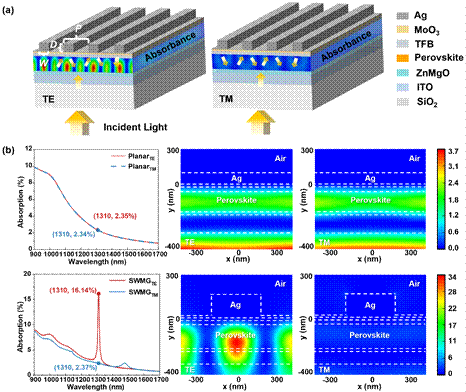
To address these challenges, the team proposed subwavelength metallic gratings (SWMGs) designed by an energy-flux-weighted absorption (EFWA) inverse algorithm, and realized perovskite photodiode-type photodetectors with high polarization sensitivity at O-band wavelengths. The design exploits the tunneling transmission of light through a thin planar silver layer together with the diffractive coupling of the top silver grating layer to effectively localize the optical field, maximizing light absorption within the perovskite active layer under polarized illumination and thereby enabling clear discrimination between orthogonal polarization states. At 1310 nm, the optimized structure achieves a transverse-electric (TE) polarized absorption of 16.14%, a 6.86-fold enhancement over the planar structure.
**Figure 1.** (a) Three-dimensional schematic of the device structure and its working principle. (b) Absorption spectra of the active layers in the planar and SWMG-integrated perovskite photodiodes under TE and TM polarization, and the optical field distributions at 1310 nm.
Following the theoretical design, the fabricated photodetector (ITO/ZnMgO/perovskite/TFB/Ag/Ag grating) exhibits a polarization anisotropy ratio of 2.31 at 1310 nm — the longest operating wavelength reported to date for perovskite polarization-sensitive photodetectors. The device delivers a responsivity of 2.14 × 10⁻² mA W⁻¹, a specific detectivity of 1.02 × 10⁷ Jones, and photoresponse times of 3.42 ms (rise) and 5.59 ms (fall). Unlike previously reported perovskite polarization-sensitive photodetectors, which mostly rely on complex manipulation of the materials' intrinsic anisotropy, this work achieves polarization response through photonic grating engineering, extending the detection wavelength into the O-band while retaining a reliable polarization anisotropy ratio. The study provides a new design strategy for improving the polarization detection performance of perovskite photodiodes in the short-wave infrared.
This work was supported by the Guangdong Provincial Major Basic Research Project (No. 2025B0303000002), the National Natural Science Foundation of China (Nos. 62475171 and 12304468), the Guangdong Basic and Applied Basic Research Foundation (No. 2025A1515011655), the Young Top-notch Talent Program of the Guangdong Provincial Special Support Plan (No. 2024TQ08X142), and the Shenzhen Science and Technology Program (JCYJ20250604144959048).
Full article: https://doi.org/10.1002/adom.71742
---






 Address: No. 3002, Lantian Road, Pingshan District, Shenzhen, Guangdong Province zip code: 518118
 Tel: 0755-23256080


