Recently, the team of Professor An Hongyu from the School of Materials Science and New Energy, Shenzhen Technology University, was invited to publish a comprehensive review paper entitled "Orbitronics: Physical Mechanisms, Core Features, and Material Systems" inActa Physica Sinica(《物理学报》), a leading authoritative Chinese-language journal in physics. The paper systematically reviews the theoretical framework and experimental progress of orbitronics, an emerging interdisciplinary field. It comprehensively elaborates on the electrical excitation and detection mechanisms of orbital currents, the core physical features of orbitronics, key material systems, and its application prospects in areas such as magnetic storage and terahertz emission, providing an important academic reference for the further development of orbitronics in China. The School of Materials Science and New Energy, Shenzhen Technology University is the first affiliation of the paper. Associate Research Fellow Yang Hui is the first author, and Assistant Professor Wang Qianwen, Professor Gao Tenghua of Wuhan University of Technology, and Professor An Hongyu are the co-corresponding authors.
In recent years, orbitronics has emerged as a new direction at the intersection of condensed matter physics and information technology. Using orbital angular momentum currents as a novel carrier of information transfer, it opens up an entirely new physical perspective for next-generation low-power, high-performance information devices. Unlike spin currents, the generation of orbital currents does not rely on strong spin-orbit coupling, enabling efficient excitation in a broader range of lighter and lower-cost material systems. However, the mechanisms underlying the generation, transport, and conversion of orbital angular momentum are far more complex than those of spin, and their underlying principles have yet to be systematically revealed.
This review comprehensively discusses the excitation mechanisms of orbitronics—the orbital Hall effect and the orbital Rashba-Edelstein effect—along with the corresponding electrical and optical detection methods. It further distills three core physical features that distinguish orbitronics from spintronics:Long-range transport: the diffusion length of orbital currents in ferromagnets can reach tens of nanometers, far exceeding that of spin currents, which is a key advantage for efficient angular momentum transfer.Different torque mechanisms: conventional spin-orbit torques rely on the strong spin-orbit coupling of the non-magnetic layer, whereas orbital torques depend on the spin-orbit coupling of the ferromagnetic layer—the orbital current must first be converted into a spin current within the ferromagnetic layer before acting on the magnetic moments.Sensitivity to atomic arrangement: the orbital response is strongly coupled with crystal symmetry, atomic ordering, and structural orientation, and can be actively tuned through means such as crystallinity, phase transitions, and orientation matching. On materials, the review systematically surveys two major categories: "orbital Hall source" materials and "orbital-to-spin conversion" materials. Light metals not only exhibit orbital Hall conductivity several times greater than the spin Hall conductivity of heavy metals, but also feature low resistivity and compatibility with semiconductor processes, demonstrating significant application potential. On applications, the review highlights recent progress in orbital-torque magnetic random-access memory (MRAM) and orbital terahertz emitters. Experiments show that using light metals such as ruthenium, niobium, and chromium as orbital Hall layers can reduce the power consumption of magnetization switching by more than 60%; terahertz emitters based on the inverse orbital Hall effect exhibit advantages such as ultra-long diffusion lengths and wide operating bandwidths.
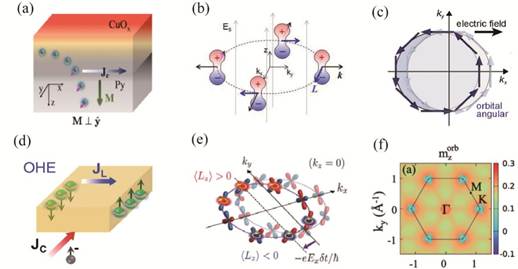
Figure 1. Schematic illustrations of the orbital Rashba-Edelstein effect and the orbital Hall effect: (a) Generation of the orbital Rashba-Edelstein effect at symmetry-broken interfaces; (b) Orbital Rashba effect: the interaction between electric dipole moments and the surface electric field; (c) Orbital Edelstein effect: non-equilibrium orbital angular momentum emerging under an applied electric field; (d) Macroscopic transport picture of the orbital Hall effect; (e) Mechanism of the orbital Hall effect driven by orbital texture in centrosymmetric materials; (f) Mechanism of the orbital Hall effect driven by intrinsic orbital moments and Berry curvature in non-centrosymmetric materials.
Harnessing the orbital angular momentum degree of freedom of electrons is expected to provide information processing approaches with higher energy efficiency and higher density for frontier directions such as spintronics and quantum computing. The publication of this review not only demonstrates Shenzhen Technology University's academic influence in the frontier field of orbitronics, but also injects new vitality into the development of interdisciplinary research between condensed matter physics and information technology in China. The innovative value of this review is reflected in three aspects: it systematically summarizes the three core physical features of orbitronics (long-range transport, dependence on spin-orbit coupling, and strong coupling with atomic arrangements), providing a complete physical picture for understanding the unique behavior of the orbital degree of freedom; it comprehensively presents the current research status and performance tuning principles of orbital Hall materials, from light metals to complex oxide interfaces, and from three-dimensional to two-dimensional materials; and it systematically elaborates the application potential of orbital torques in emerging fields such as low-power magnetic storage and efficient terahertz emission, offering a clear technical roadmap for translating orbitronics from fundamental research into practical applications.
This research was supported by the National Natural Science Foundation of China (Grant Nos. 52571262, 52522214, 52372092), the Natural Science Foundation of Guangdong Province (Grant No. 2025A1515012499), the Featured Innovation Project for Regular Institutions of Higher Education of the Department of Education of Guangdong Province (Grant No. 2024KTSCX056), and the International Science and Technology Cooperation Project of the Hubei Provincial Regional Science and Technology Innovation Plan (Grant No. 2024EHA025), among others. In recent years, Professor An Hongyu's team, focusing on spin-orbitronics and magnetic nanofilms, has made a series of important advances in frontier directions such as orbital torque generation mechanisms, high-efficiency spin-orbit conversion materials, and magnetization switching control, and has published multiple important papers in leading international journals. The team's work not only provides solid experimental evidence for understanding the physical mechanisms of orbitronics, but also lays the material and device foundation for the development of low-power, high-performance spintronic/orbitronic devices.
Paper link:https://wulixb.iphy.ac.cn/article/doi/10.7498/aps.75.20260288






 Address: No. 3002, Lantian Road, Pingshan District, Shenzhen, Guangdong Province zip code: 518118
 Tel: 0755-23256080


